

Texas history
The Annexation of Texas
Texas joined the United States in 1845 as a country making its own decision, through a convention and a vote of its people. This is how it happened.
Texas was annexed to the United States on December 29, 1845, and became the 28th state. It didn't get there by conquest or by petitioning as a territory. It was an independent country, the Republic of Texas, and it joined because its own convention and its own voters decided to.
Texans asked first
The idea came from Texas. In September 1836, months after independence, Texans voted overwhelmingly in favor of annexation. Memucan Hunt, the Texas minister in Washington, formally proposed it on August 4, 1837.
Secretary of State John Forsyth declined three weeks later. The reasons he gave came down to Mexico. Texas and Mexico were still formally at war, the United States was bound to Mexico by a treaty of amity and commerce, and taking Texas in would have meant taking on that war. The administration also raised a constitutional doubt, and it's worth reading closely.
The constitutional question
The United States had grown before. It bought Louisiana from France in 1803 and Florida from Spain in 1819. Forsyth wrote that those cases were "materially different," because both lands had been "colonial possessions of France and Spain, and therefore dependant on the metropolitan Governments."
Texas was another matter. It was, in Forsyth's words, "a State, with an independent government, acknowledged as such by the United States." He used "State" the way the law of nations did, for a sovereign country. Whether the Constitution "contemplated the annexation of such a State, and, if so, in what manner that object is to be effected," were questions that President Van Buren thought it "inexpedient, under existing circumstances, to agitate."
So the federal government had recognized Texas as a sovereign country, and it wasn't sure its own Constitution let it take one in. The federal government holds only the powers the states delegated to it, and none of them said anything about absorbing a foreign country. That question never went away. It came back every time annexation did.
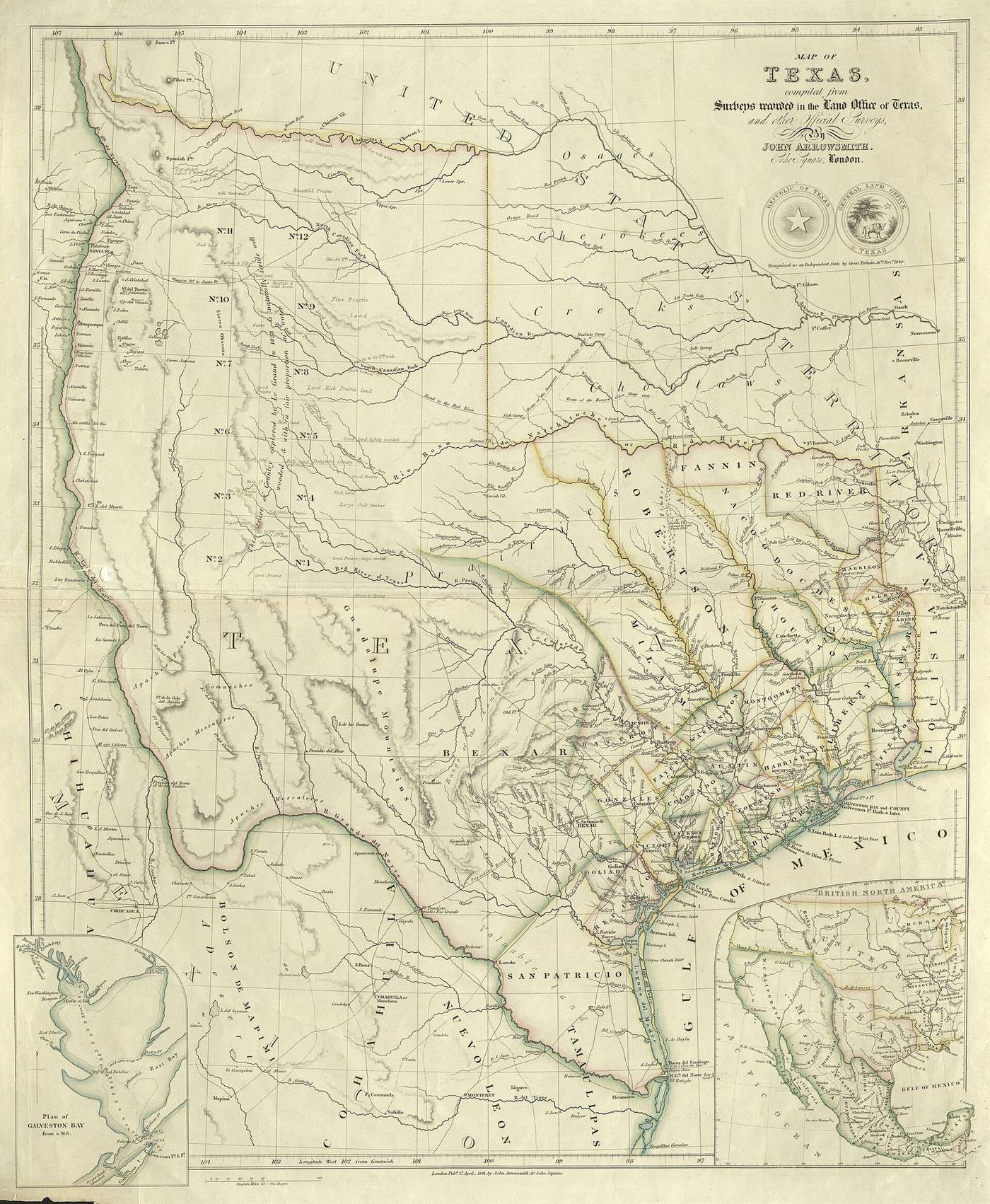
The question didn't die there. Memorials and petitions in favor of annexation reached Congress that winter, but Congress wouldn't act on them. John Quincy Adams held the House floor against it for three weeks in 1838, and Congress adjourned that summer without acting on it. On October 2, 1838, President Houston withdrew the offer. Mirabeau B. Lamar, who took office that December, didn't reopen it. For the next several years Texas ran its own affairs as a country, and other nations dealt with it as one.
Britain and a failed treaty
By 1843 Washington was alarmed by Britain's interest in Texas. Britain opposed annexation because it wanted to check U.S. expansion westward and to win Texas trade for itself. President John Tyler concluded that Texas must not fall under British influence and proposed annexation. Sam Houston, then in his second term, agreed to negotiate a treaty. A treaty needs two-thirds of the Senate, and it didn't come close. The Senate rejected it 16 to 35 on June 8, 1844.
Annexation became the issue of the 1844 presidential election, and James K. Polk, who favored it, won.
The joint resolution
With the treaty dead, Tyler turned to a joint resolution of Congress, which needed only a simple majority in each house rather than the two-thirds of the Senate a treaty requires. Congress passed it on February 28, 1845, and Tyler signed it on March 1.
The constitutional doubt from 1837 came straight back. Opponents said Congress had no power to do this by resolution. Robert Winthrop of Massachusetts told the House on January 6, 1845, that he denied "the authority of this Government to annex a foreign nation to our Union, by any process whatever, short of the general consent of the people." He read Forsyth's 1837 letter into the record. The resolution was written under the power the Constitution gives Congress to admit new states: Congress consented that Texas "may be erected into a new State." It passed the Senate 27 to 25.
The doubts in that debate were about Washington's power, not about Texas's right to decide for itself.
The resolution offered Texas statehood on terms Texas could accept or refuse:
- Texas would keep its public lands and its public debt, and the United States would not take on that debt.
- Texas would hand over its forts, harbors, navy, and other means of public defense.
- New states, up to four in addition to Texas, could later be formed from its territory with Texas's consent.
- The United States would settle any boundary questions with other governments.
Texas decided
Britain still hoped to stop it. On British advice, Mexico offered to recognize Texas independence, on the condition that Texas not join any other country. President Anson Jones called the Texas Congress into session on June 16, 1845, and an elected convention met on July 4. He put the choice to both bodies: annexation, or independence recognized by Mexico. Both chose annexation.
The convention wrote a state constitution, and Texas voters approved annexation and the new constitution in October 1845. The U.S. Congress accepted the Texas constitution, and President Polk signed the act on December 29, 1845, the date Texas legally entered the union. The formal handover came on February 19, 1846. The Republic's flag came down in Austin, and Jones declared that "the Republic of Texas is no more."
What Texas kept
Texas joined on terms no other state got. It kept its public lands and its public debt, and it kept the option to divide into as many as four more states.
It also kept what every state holds: the right of its people to govern themselves. When Virginia, New York, and Rhode Island ratified the Constitution, each wrote that the powers it was delegating could be resumed by the people, and Congress seated all three. Every state enters the union on an equal footing with the original states, so what those states reserved, Texas holds in equal measure.
Texans also put it in writing themselves. The same October 1845 vote that approved annexation approved a state constitution whose Bill of Rights opens: "All political power is inherent in the people, and all free governments are founded on their authority, and instituted for their benefit; and they have at all times the unalienable right to alter, reform, or abolish their form of government, in such manner as they may think expedient." Texans carried that right into the union with them, and Article 1, Section 2 of the Texas Constitution still says it. How that right was reserved walks through the full case.
Why it matters now
Texas entered the union the way a country makes a serious decision: through a convention of elected delegates and a vote of the people, after weighing a real alternative. Congress offered terms, and the consent that made Texas a member was Texas's own. That's the precedent the Texas Nationalist Movement points to. A question Texans settled by their own vote in 1845 can be put to their vote again, through the Texas Independence Referendum Act and a binding referendum. Whether Texas can lawfully do it is answered here.
686,330 Texans across all 254 counties are on record asking for that vote.
Texas First. Texas Forever.